> ## Documentation Index
> Fetch the complete documentation index at: https://docs.endorlabs.com/llms.txt
> Use this file to discover all available pages before exploring further.
# AI Model Discovery
> Discover and evaluate AI models with comprehensive scoring for security and operational risk.
An AI model is a computational system designed to simulate human intelligence by performing tasks such as recognizing patterns, making decisions, predicting outcomes, or generating content. Many open source AI models are freely available for use, modification, and distribution. Just like dependencies, these AI models can bring operational and security risks in the organization that uses them. Gaining visibility into these risks can minimize the vulnerabilities introduced by them.
Endor Labs picks the top ten thousand open source AI models available on Hugging Face and assigns Endor scores to them, so that you can make informed decisions before using them in your organization.
You can search for AI models in the following ways:
* **View detected AI models**: Select **Inventory** > **AI Models** from the left sidebar to see AI models discovered in your namespace.
* **Search AI models from Hugging Face**: Select **Discovery** > **AI Models** from the left sidebar to search and evaluate models.
* Type in the search bar and click **Search AI Models**.
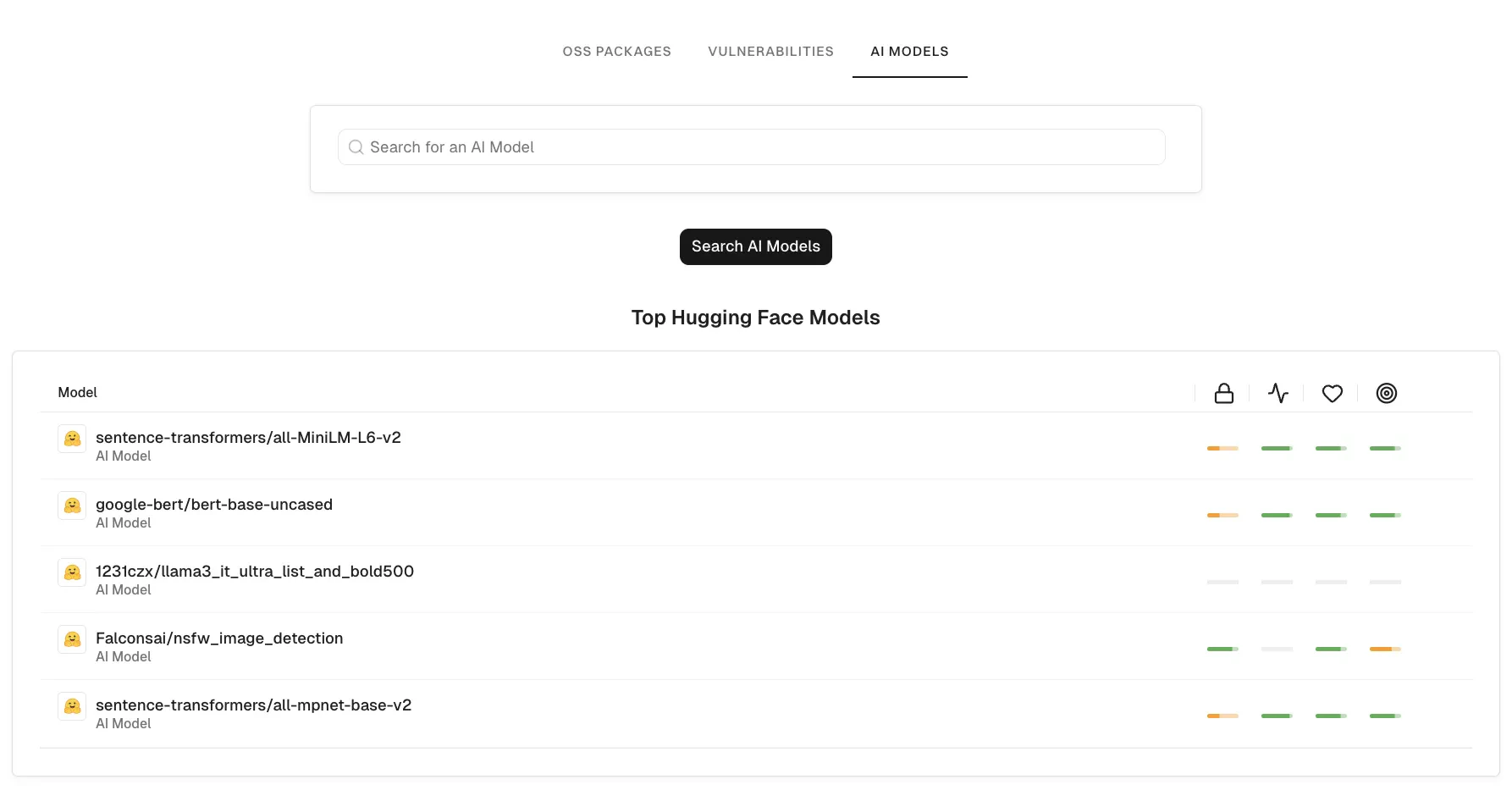 * Select a result to view details such as security, activity, popularity, and operational risk score.
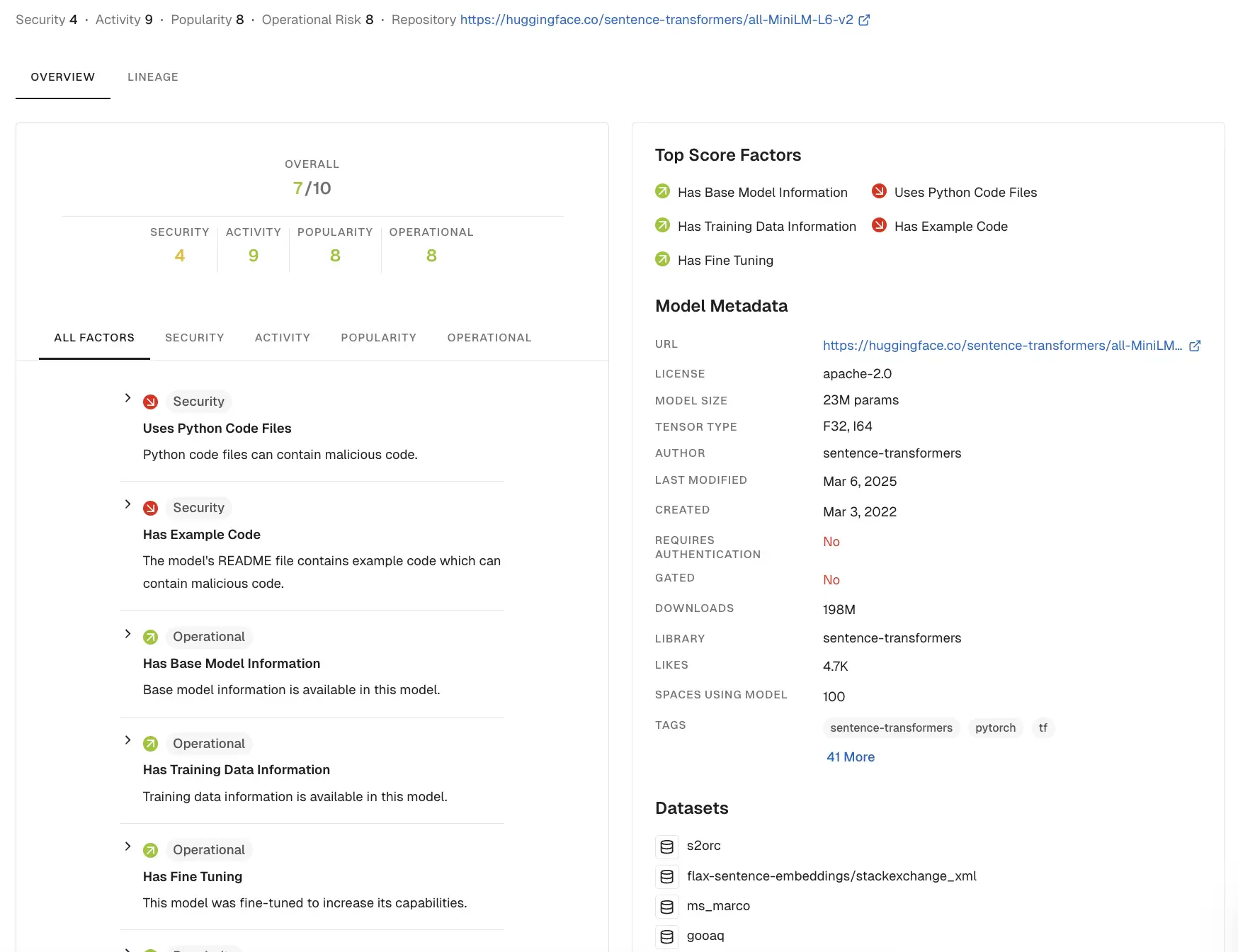 * Click **Go to Hugging Face to see more** to open the model on the Hugging Face website.
## Understand the scores
Each model carries an Endor score across four categories. Expand a category to see the factors that feed into it.
The popularity score reflects the model's adoption and recognition within the AI community. Higher scores indicate greater usage and community engagement.
* **Number of downloads**: More downloads indicate widespread adoption.
* **Number of likes**: More likes suggest a positive reception from users.
* **Published papers**: Models with linked academic papers receive higher credibility.
* **GitHub repository**: Models with an associated GitHub repository score higher.
* **Number of spaces using the model**: More integrations suggest broader utility.
Models with many downloads, likes, citations, and integrations score higher. Models with fewer engagements score lower.
The activity score measures how actively a model is discussed and maintained.
* **Discussion posts**: Active community discussions contribute positively.
* **Pull requests**: Indicates ongoing maintenance and improvements.
Models with frequent discussions and active pull requests score higher. Models with limited activity receive lower scores.
The operational score assesses the model's reliability, transparency, and usability.
* **Reputable provider**: Models from well-known sources score higher.
* **Model age**: Older, well-maintained models may score higher, but outdated models may receive penalties.
* **Authorization requirements**: Restricted-access models score lower for accessibility but may gain points for security.
* **Gated models**: If a model requires special access, it may impact usability.
* **License information**: Models with clear licensing receive higher scores.
* **License type**: Open licenses (permissive, unencumbered) generally score higher than restrictive ones.
The following metadata factors are also considered.
* **Metric information**: Essential for model evaluation.
* **Dataset information**: Transparency about training data boosts the score.
* **Base model information**: Important for derivative works.
* **Training data, fine-tuning, and alignment training information**: Increases credibility.
* **Evaluation results**: Demonstrates model performance.
Models with comprehensive metadata, reputable providers, and clear licensing score higher. Models with unclear ownership, restrictive access, or missing details score lower.
The security score evaluates potential risks associated with a model's implementation and distribution.
* **Use of safe tensors**: Secure tensor formats boost the safety score.
* **Use of potentially unsafe files**: Formats such as pickle, PyTorch, and Python code files pose security risks.
* **Typosquatting risks**: Models that could be impersonating popular models receive lower scores.
* **Example code availability**: Models that contain example code or code snippets can introduce potential issues and hence receive lower scores.
Models that follow best security practices such as safe tensors, clear documentation, or vetted repositories score higher. Models receive lower scores if they use potentially unsafe formats such as pickle (`.pkl`) and unverified PyTorch (`.pth`) or show signs of typosquatting.
For how the categories combine into a final score, see [AI model scores](/secure-ai-coding/ai-model-scores).
* Click **Go to Hugging Face to see more** to open the model on the Hugging Face website.
## Understand the scores
Each model carries an Endor score across four categories. Expand a category to see the factors that feed into it.
The popularity score reflects the model's adoption and recognition within the AI community. Higher scores indicate greater usage and community engagement.
* **Number of downloads**: More downloads indicate widespread adoption.
* **Number of likes**: More likes suggest a positive reception from users.
* **Published papers**: Models with linked academic papers receive higher credibility.
* **GitHub repository**: Models with an associated GitHub repository score higher.
* **Number of spaces using the model**: More integrations suggest broader utility.
Models with many downloads, likes, citations, and integrations score higher. Models with fewer engagements score lower.
The activity score measures how actively a model is discussed and maintained.
* **Discussion posts**: Active community discussions contribute positively.
* **Pull requests**: Indicates ongoing maintenance and improvements.
Models with frequent discussions and active pull requests score higher. Models with limited activity receive lower scores.
The operational score assesses the model's reliability, transparency, and usability.
* **Reputable provider**: Models from well-known sources score higher.
* **Model age**: Older, well-maintained models may score higher, but outdated models may receive penalties.
* **Authorization requirements**: Restricted-access models score lower for accessibility but may gain points for security.
* **Gated models**: If a model requires special access, it may impact usability.
* **License information**: Models with clear licensing receive higher scores.
* **License type**: Open licenses (permissive, unencumbered) generally score higher than restrictive ones.
The following metadata factors are also considered.
* **Metric information**: Essential for model evaluation.
* **Dataset information**: Transparency about training data boosts the score.
* **Base model information**: Important for derivative works.
* **Training data, fine-tuning, and alignment training information**: Increases credibility.
* **Evaluation results**: Demonstrates model performance.
Models with comprehensive metadata, reputable providers, and clear licensing score higher. Models with unclear ownership, restrictive access, or missing details score lower.
The security score evaluates potential risks associated with a model's implementation and distribution.
* **Use of safe tensors**: Secure tensor formats boost the safety score.
* **Use of potentially unsafe files**: Formats such as pickle, PyTorch, and Python code files pose security risks.
* **Typosquatting risks**: Models that could be impersonating popular models receive lower scores.
* **Example code availability**: Models that contain example code or code snippets can introduce potential issues and hence receive lower scores.
Models that follow best security practices such as safe tensors, clear documentation, or vetted repositories score higher. Models receive lower scores if they use potentially unsafe formats such as pickle (`.pkl`) and unverified PyTorch (`.pth`) or show signs of typosquatting.
For how the categories combine into a final score, see [AI model scores](/secure-ai-coding/ai-model-scores).